
Hamnet Revisited

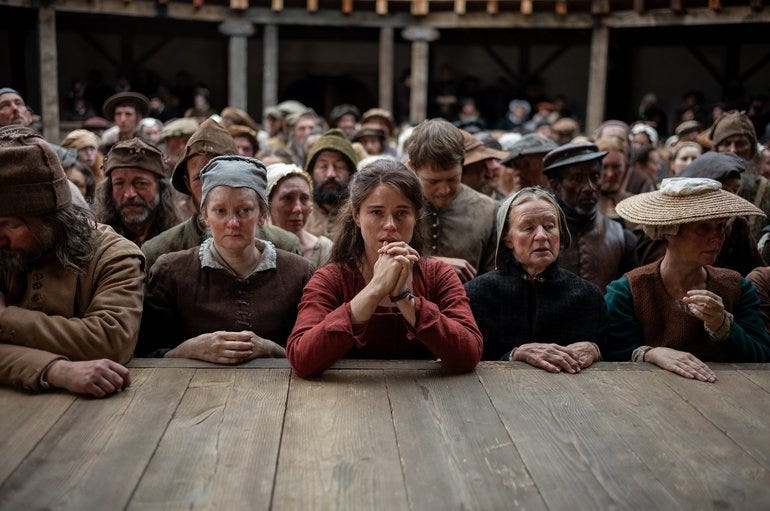
Since the two pieces I wrote about the Hamnet movie are behind paywalls, I thought it might be worth reprinting them here - in slightly different form, that is to say the “raw” submissions as opposed to the final versions much improved by my editors at the Sunday Times and New Statesman.
The Times commission was to distinguish between the story of the novel/movie and the facts that we know about Hamnet Shakespeare’s death and its influence on Hamlet. Naturally, a lot of the (many) under-the-line readers’ comments went along the lines of “It’s a fiction, a good story, who cares about the historical facts?” All writers working with historical material rearrange their sources and introduce entirely fictional elements. Hullo Shakespeare: Sir John Oldcastle wasn’t really like Sir John Falstaff; Prince Hal and Harry Hotspur weren’t really of the same generation (Shakespeare introduced that change to make them into two sides of the same dramatic coin). And hullo Hilary Mantel: there’s a positive industry of people extracting the fact from the fiction in the magnificent Wolf Hall trilogy (here’s an example). The problem, I suggested in the article, is that many people believe what they see in historical movies, or read in historical novels, so it is a form of public service - especially in the age of “my truth” and “fake news” - to fill in the real historical background. That’s a different thing from making a judgment about the quality of the creative work - something I do rather more in the second piece, which I’ll reprint here tomorrow.
I should add that, in order to hit my word limit, I left out a paragraph I was intending to write about the now neglected Shakespeare play King John. It has an exceptionally moving speech spoken by a mother, Constance, about the loss of a child. Biographers have often linked it to Hamnet’s death, but, though it is a far more likely connection to Hamnet than anything in Hamlet, that is still very speculative - especially as King John may well have been written before Hamnet’s death. (The dating of King John and its relation to a play called The Troublesome Reign of King John is one of many unresolved questions that keeps the wheels of Shakespearean scholarship turning - the kind of thing to which I’ll return in future posts.) Anyway, for those who don’t know it, here is Constance’s speech:
Grief fills the room up of my absent child:
Lies in his bed, walks up and down with me,
Puts on his pretty looks, repeats his words,
Remembers me of all his gracious parts,
Stuffs out his vacant garments with his form;
Then have I reason to be fond of grief?
Fare you well: had you such a loss as I,
I could give better comfort than you do.
[She unbinds her hair]
I will not keep this form upon my head,
When there is such disorder in my wit:
O Lord, my boy, my Arthur, my fair son,
My life, my joy, my food, my all the world:
My widow-comfort, and my sorrows’ cure!
I’m afraid I was dry-eyed throughout Hamnet - but this speech always has me welling up. Especially that image of the “vacant garments.” Deciding what to do with the clothes of a dead child must be one of the hardest things in the world.
Anyway, here’s the original submitted text of the Sunday Times piece, with the second article - some reflections on Paul Mescal as the man himself - to follow tomorrow.
Hamnet, the new Chloé Zhao film about the death of Shakespeare’s only son, has hit the cinema screens to an unusually mixed reaction. There are the five star reviews, the reports of sobbing audiences, the Golden Globe win and the Oscar prediction for Jessie Buckley as Shakespeare’s wife, Agnes (a.k.a. Anne) Hathaway. And then there are the two star excoriations and the claim in the New Yorker that this is the ultimate example of “grief porn.” So, as a Shakespeare fanatic, this week I felt compelled to see it.
I snagged the last available Tuesday night ticket and drove up to the lovely little Living Room cinema in Chipping Norton, in the hope that I would see David Cameron, Jeremy Clarkson and Ellen DeGeneres weeping in the aisles. The street was uncannily dark, which felt propitious for a play that begins with the appearance of a ghost by night. But on entering the cinema, I was told that there had been a massive power cut and the screening was cancelled. So I had to go back to the following day’s matinee, where I sat in a half empty auditorium among—how shall I put it?—a more senior demographic. No tears were registered: these were tough old birds who had probably witnessed enough real life grief not to be reduced to floods by what Hamlet, when the player weeps for Hecuba, calls “a fiction, a dream of passion.”
The film was beautifully shot and Jessie Buckley certainly ran the full gamut of emotions, but I came away convinced that it was based on a false premise. In the author’s note at the end of Maggie O’Farrell’s highly acclaimed novel, which she adapted for the movie, she wrote that “The Black Death or ‘pestilence’, as it would have been known in the late sixteenth century, is not mentioned once by Shakespeare, in any of his plays or poetry. I have always wondered about this absence and its possible significance; this novel is the result of my idle speculation.” In other words, Shakespeare was so traumatized by the cause of his only son’s death that he never wrote about the plague. The film duly has a haunting scene of plague deaths in the city and a poignant moment when young Judith Shakespeare, buboes on her body, infects her twin brother Hamnet and he nobly dies in her place.
The pestilence not mentioned once? The word “plague” occurs more than a hundred times in Shakespeare’s plays and the pivot of the tragedy of Romeo and Juliet is that the Friar commissioned to tell Romeo that Juliet is not really dead (having merely taken a sleeping potion rather than a poison) fails to deliver his message because he is quarantined in a house which has been struck by the “infectious pestilence.” A twist of misfortune that gives new meaning to Mercutio’s final words, “A plague on both your houses.”
Recurrent outbreaks of plague, leading to mass deaths and government enforced lockdowns, were an indelible feature of the Elizabethan age. The parish register of Holy Trinity Church in Stratford-upon-Avon records the baptism of William Shakespeare in April 1564. But a few weeks later, a clerk made a marginal annotation opposite the death of Oliver Gunne, apprentice: “Hic incepit pestis.” Here began the plague. A mere twenty deaths were recorded in the first half of that year, a full two hundred in the second half. One in seven residents of the small market town. It was a pure matter of luck that baby Will survived. If he had not, we would now be saying that Christopher Marlowe or Ben Jonson was the greatest dramatist in English history. And the whole course not just of English literature but of global culture would have been different.
But there was no recurrence of mass burials in Stratford in the summer of 1596, when Shakespeare’s eleven year old son died. No evidence of an outbreak of the pestilence. Youth mortality was widespread in the age, with many possible causes. It is almost certain that Hamnet did not die from the plague.
Does this matter? Hamnet is a novel, and now a much-hyped film, not a biography or a documentary. O’Farrell, whose story powerfully evokes the spread of plague across Europe, is perfectly entitled to her “idle speculation.” But as a scholar and teacher of Shakespeare I have to be aware that many people believe what they see in the movies. I am still smarting from the fact that I loved Baz Luhrmann’s Romeo + Juliet, but had to contend with a student assuming that in the original play Mercutio voices his fantasia about Queen Mab after popping an ecstasy pill. How many punters will leave the cinema with the conviction that Hamnet died of plague, that Shakespeare was an absent father, and that Hamlet was written as a way of expiating his son’s death?
For anyone interested in historical fact, the movie is frustrating. Not only because there was no plague in Stratford in 1596, but also because a version of Hamlet, perhaps by Thomas Kyd and perhaps by Shakespeare himself, was on stage long before Hamnet died, destroying the whole premise. Because we were never told that Hamnet and Judith were named after their godparents, a Stratford baker and his wife. And because of some fascinating recent research by the Bristol University archival scholar Matthew Steggle. He has shown that a fragment of a letter addressed to “good Mrs Shakespeare”, preserved by accident in the binding of a book in Hereford, appears to show both of the Shakespeares living together in central London at some point in the first decade of the seventeenth century. That would confound the old view that Shakespeare was like some modern businessman who spends all his time in the city, all the while neglecting his wife and children in the Cotswolds. And it makes a mockery of the scene when Jessie Buckley goes to the Globe theatre and can’t make head or tail of Hamlet because she has never seen a play before.
Besides, Hamlet is a play about mourning and avenging a dead father, not a dead son. As the action of Hamnet is moving towards the staging of Hamlet, there is brief mention of Shakespeare’s father’s death. For a moment I thought we might be going down Sigmund Freud’s rabbit hole: he was convinced that Shakespeare wrote Hamlet as a way of dealing with his Oedipal relationship with his father and mother. He wants to sleep with Gertrude, so cannot bring himself to kill Claudius, since he really wanted to kill his father himself. But this idea was not pursued, despite the film making use of the tradition that Shakespeare’s best performance as an actor was in the role of the ghost of old Hamlet. As for Freud, shortly after proposing his theory, new scholarship revealed that the play was written before Shakespeare’s father died, so in order to stick with his reading the good doctor switched horses and proposed that the plays were really written by the Earl of Oxford, whose father was dead!
The most touching aspect of the film was the relationship between the twins, Hamnet and Judith—and it confirmed my view that the real influence of Hamnet’s death on Shakespeare is to be seen in Twelfth Night, a play filled with death and loss but ending with an imagined and astonishingly beautiful reunion of the separated twins. What is more, it was staged at the Middle Temple on the anniversary of the baptism of his own twins. I left the cinema wanting to see a film in which my favourite comedy was a gift from a loving father to a daughter bereft of her twin.
Lovely yes, the end of Twelfth Night has sent me to tears more than any moment in any Shakespeare and this is a good insight.
I haven't read or seen Hamnet but I suspect that there is a distinction to be made between fictive reimagining done with artistic good faith and salacious misrepresentation for shock value. Take a bow Pandaemonium - about as historically and aesthetically accurate about early English romanticism as Springtime for Hitler was about WW2. Brace yourself for "Wuthering Heights".