Is All True?
Late Shakespeare Again

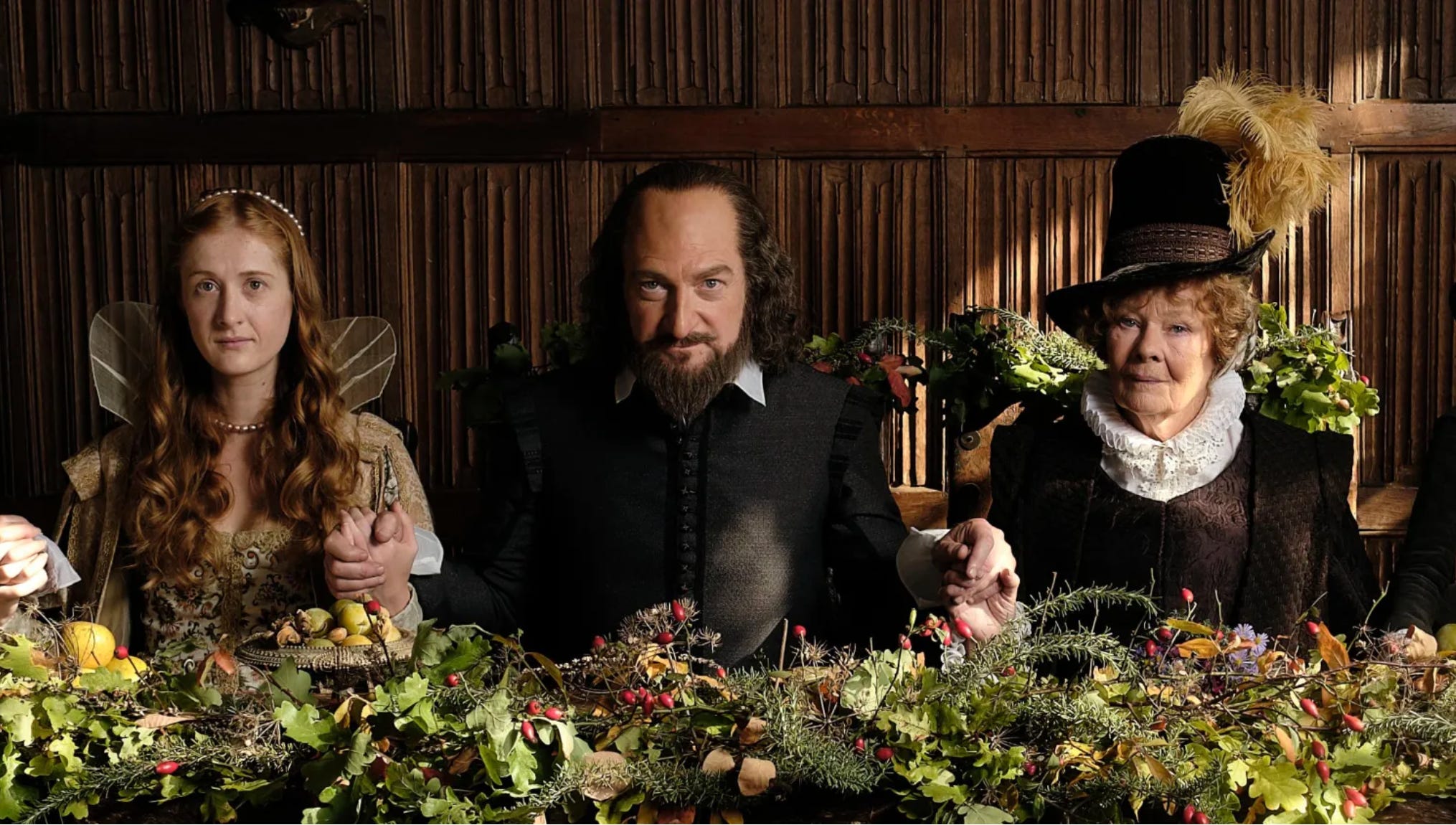
While I’m thinking about Shakespeare biopics and pulling stuff from behind paywalls, I thought it would be worth posting - once again, in its submitted as opposed to edited form - my London Times article that asked the same question of Kenneth Branagh’s movie about Shakespeare’s last years that I asked of Hamnet: how much of All is True is true? Perhaps an even more pertinent question, given the title … (And you’ll see that my enthusiasm for Upstart Crow and the King John quote make an appearance there, too.)
On 29 June 1613, Sir Henry Wootton, politician and sometime Ambassador to Venice, went to the Globe Theatre on Bankside to see the King’s Men in their new play. He reported in a letter to a friend that it was “called All is True, representing some principal pieces of the reign of Henry the Eighth.” It “set forth with many extraordinary circumstances of pomp and majesty even to the matting of the stage, the knights of the order with their Georges and Garter, the guards with their embroidered coats, and the like: sufficient in truth within awhile to make greatness very familiar, if not ridiculous.” Towards the end of the first act, actors playing Henry VIII and some of his courtiers changed into shepherds’ costumes and readied themselves to come on stage to perform a masque (a jolly dance routine) at a feast in Cardinal Wolsey’s house. To herald their entrance, and add to the spectacular quality of the play, a stagehand fired off a cannon in the roof space below the thatch of the “wooden O,” as William Shakespeare had once called his theatre.
Ignition, mishap: the wadding flew into the thatch and a wisp of smoke rose from the theatre roof. The backstage crew were busy waiting for their next cue. By the time they noticed the fire, it was too late. The theatre was destroyed. Miraculously, it was evacuated without any serious injury – according to Sir Henry Wootton, one man’s breeches caught fire but a resourceful fellow-spectator put it out with a bottle of ale.
Kenneth Branagh’s new film takes its title from the fatal play: All is True. It begins with a back view of Shakespeare in silhouette, watching the Globe, the crucible of his genius, being burned to the ground. A caption tells us that “William Shakespeare never wrote another play.” Next thing we know, his horse is thundering home to sleepy Stratford-upon-Avon, where he will spend the rest of the movie absorbed in family affairs. Cleverly, script-writer Ben Elton – fresh from his brilliant Shakespeare sit-com Upstart Crow – cues his darker theme with some lines from the Prologue to All is True, which was published in Shakespeare’s First Folio as The Famous History of the Life of King Henry the Eight:
Be sad, as we would make ye think ye see
The very persons of our noble story
As they were living; think you see them great,
Then in a moment, see,
How soon this mightiness meets misery.
Elton, nephew of the towering Tudor historian Sir Geoffrey Elton, has done his research: Shakespeare’s last years were not a bundle of laughs. In scene after scene, His Mightiness does indeed meet misery.
The title of the film is a deliberate provocation: it asks us to wonder just how much is true. Was it because of the 1613 Globe fire that Shakespeare retired to Stratford? Did his elder daughter Susanna, married to local physician John Hall, catch an STD from a married haberdasher named Ralph Smith? Is it true that this was a slander which she denied in court, with the result that her malicious accuser, one John Lane, was excommunicated? Was the marriage of Shakespeare’s younger daughter Judith marred from the outset by the discovery that her fiancé, Thomas Quiney, had impregnated a girl named Margaret Wheeler, who died in childbirth (along with the child) just a few weeks after old Will hosted Judith’s wedding? Did that lead him to change his will, in order to protect her inheritance from this unreliable new son-in-law? And, whilst doing so, did he take the opportunity to insert a clause leaving his “second-best bed” to his wife Ann?
The answer to all these family questions is yes, all is true. In this respect Uncle Geoffrey would have given young Ben a B+. But in the accompanying tutorial, he would have torn the lad to shreds on the detail. For a start, there are those rather moving lines from the Prologue to Henry VIII: they were written not by Shakespeare, but by his collaborator John Fletcher. Scholars have known for a hundred and fifty years that this was a co-authored play. As was The Two Noble Kinsmen, which was almost certainly written after Henry VIII, giving the lie to the claim that Shakespeare never wrote another play. Equally, the fact that Shakespeare was grooming Fletcher as his successor by co-writing these two plays – and another lost one, called Cardenio – suggests that he saw retirement as a gradual process, not a sudden one.
The film gives the impression that Shakespeare never returned to London. This is not true. In November 1614, a friend met him there to discuss business. A few months before the Globe fire, he had purchased and mortgaged a buy-to-let property adjacent to his company’s other theatre, the Blackfriars. In earlier years, all his canny property investments had been in Stratford: late in life, he was diversifying his asset base in the city.
The London business meeting in late 1614 concerned a dispute over the enclosure of some land back home, in which Shakespeare had a financial stake. He looked after his own interests, as opposed to those whom his King Lear called the “poor naked wretches” who survived off the commons. This led the Marxist dramatist Edward Bond, in his 1973 play Bingo: Scenes of Money and Death, to represent the Bard as a rapacious capitalist. Elton and Branagh make no mention of the enclosure dispute, concentrating instead on the family saga.
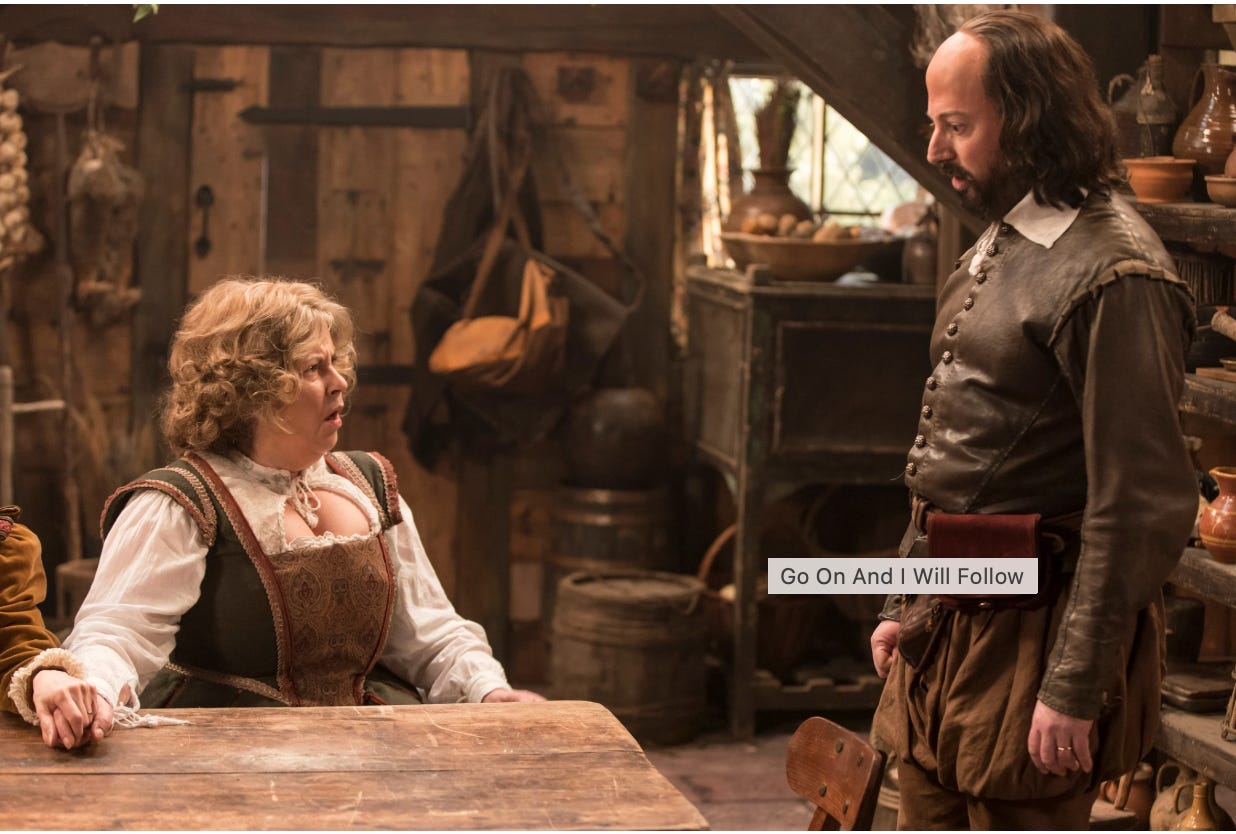
Series three of Upstart Crow ended with a turn from comedy to tragedy almost as moving as the celebrated “over the top into no man’s land” finale of Blackadder Goes Forth: Will returns to Stratford in 1596 to find that his only son Hamnet has died at the age of eleven. This is the loss that haunts the whole of All is True. Given the importance of male heirs in sustaining a name and an estate, and the fact that Shakespeare only had one grand-daughter (Elizabeth, Susanna’s daughter by Dr John Hall), it is perfectly reasonable to imagine him meditating on how, to use the lines from another of his lesser-known history plays, King John, that are quoted in Upstart Crow,
Grief fills the room up of my absent child,
Lies in his bed, walks up and down with me,
Puts on his pretty looks, repeats his words,
Remembers me of all his gracious parts,
Stuffs out his vacant garments with his form.
Cinemagoers will fully understand that the scenes in All is True during which the ghost of young Hamnet appears to his ageing father come from the imagination, not the archival record. The “mind’s eye” is, after all, the place from where the ghost of Old Hamlet comes to Young Hamlet in Will’s most famous play.
So, yes, it is true that Hamnet died on the threshold of adolescence and that the vacancy was never filled. It is also true, as the film explains, that he is unlikely to have died of plague: the evidence of the parish register indicates that 1596 was not one of the years when an epidemic hit Stratford, as so often occurred. However, when it comes to the supposed circumstances of Hamnet Shakespeare’s death, one is tempted to stand up in the cinema and shout, as Leontes does in the scene of The Winter’s Tale during which his only son Mamillius dies at a similar age, “There is no truth at all in the oracle.” The Elton-Branagh fantasy is that, just as Ophelia drowns herself because she has been rejected by Hamlet, so Hamnet drowns himself because he cannot bear the shame of his father discovering that the poems of youthful genius he has written in order to prove himself worthy of the Shakespeare name were in fact composed by his sister Judith. He was only the amanuensis, the scribe who was needed because girls did not go to school, meaning that Judith was unable to write.
Elton has picked up an interesting detail from the archival record: Judith Shakespeare once witnessed a deed of conveyance by signing her “mark.” This is usually taken to mean that she was illiterate. In fact, people who could write did sometimes simply sign with a mark for convenience or by custom. But there is no doubt that in Shakespeare’s time female literacy lagged far behind male, especially in rural communities. And there is potency in the idea that the greatest writer in the history of the world had a daughter who could not write. The film accordingly imagines Will gaining comfort during his last days as his firstborn, the more educated Susanna – who truly was her father’s daughter, renowned for being “witty above her sex” – teaches both her mother and her sister to write. “By the time you are better I shall have written you a poem,” says Judith. But of course Will doesn’t get better: he dies after a night carousing with his old friend and rival Ben Jonson, a detail that is probably true.
The invented plot of Judith Shakespeare becoming a writer offers something akin to the strategy of Upstart Crow, in which the life of Shakespeare is embedded in the Elizabethan age but given a twenty-first century spin. The latter part of All is True seeks to reinvent the legacy of the Bard for the MeToo age. For those in the know, it is also a nod to a famous chapter in Virginia Woolf’s feminist classic A Room of one’s own: “Let us imagine, since facts are so hard to come by, what would have happened had Shakespeare had a wonderfully gifted sister, called Judith, let us say.” What would have happened, Woolf suggests, would have been lack of opportunity, constraint within marriage, frustration, then despair, ultimately suicide. So it would have been in the 1620s, proposed Woolf in the 1920s (before she too drowned herself like Ophelia). For Ben Elton, things are different now that we have 2020 gender vision.
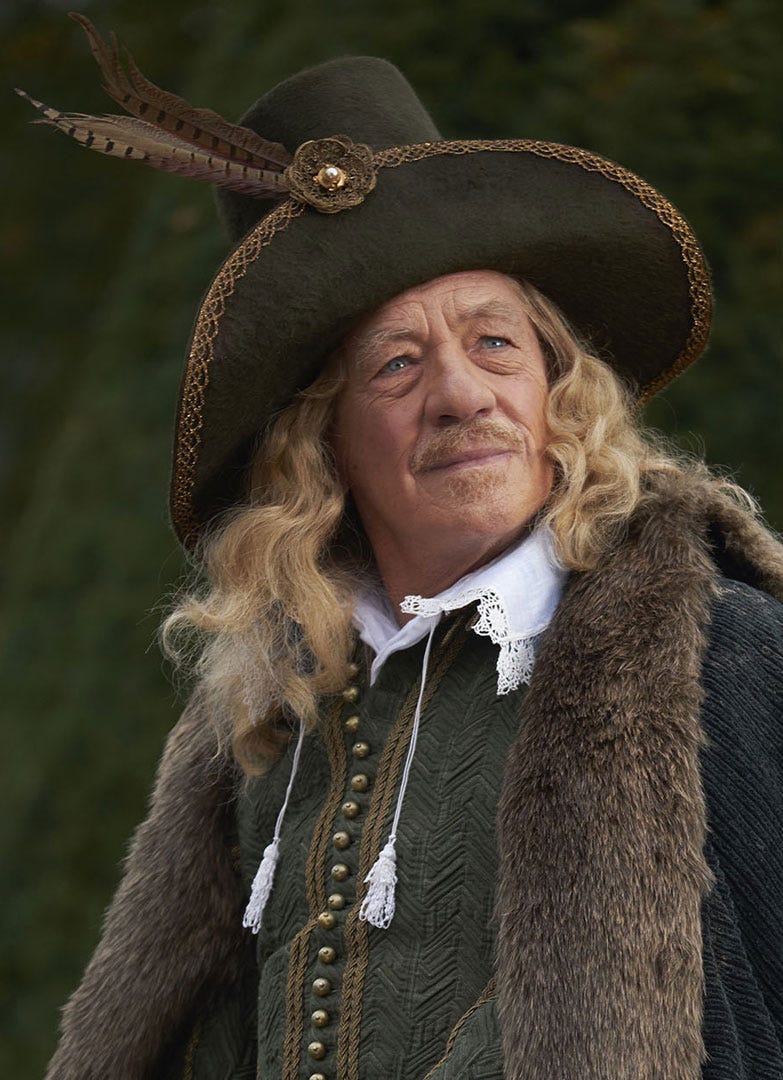
We are also, of course, thoroughly relaxed about homosexual love, which in Shakespeare’s time constituted a capital crime (if acted upon). Nearly every respectable Elizabethan poet had a sequence of sonnets in their repertoire. All are addressed to women, with two exceptions, those of a chap called Richard Barnfield and those of the man who wrote in one of his, “My name is Will” – and who penned a lot of very rude puns about where he would like to put his will. Scholars have long debated whether the beautiful youth for whom Shakespeare wrote his beautiful love sonnets was the Earl of Southampton or the Earl of Pembroke. Elton plumps for Henry Wriothesley, Earl of Southampton, and writes an entirely invented scene in which he – for it is he, the one and only Sir Ian McKellen – visits his humble servant in his Stratford retirement. If you choose to see the film, you are advised to set aside the slight problem of mismatched ages: had such a visit really occurred, Shakespeare would have been 50, Wriothesley 40, whereas Branagh is not quite 60, McKellen turning 80. Who cares? Shakespeare’s closest friend Dick Burbage was only 40 when he created the role of the 80 year old King Lear. What you should do instead is close your eyes and listen to McKellen reciting one of the sonnets. The magic of the words transcends the truth of the history.