
Plagiarism Revisited
and the Upstart Crow

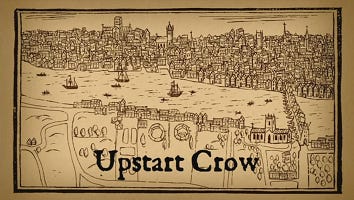
This post is a follow-up to last week’s reflections on Coleridge.
Academic plagiarism has been much in the news, because of a case in Cambridge England that has evoked comparisons with a case in Cambridge Massachusetts (aka Harvard). The Francesca Gino affair, which involved alleged data manipulation as well as alleged plagiarism, had a certain karma because her research specialism is honesty and unethical behaviour - and no doubt it stirred emotions because she was allegedly on a salary of more than a million dollars a year. The Cambridge affair raises a different set of questions which are bound up with the thorny question of diversity and inclusion, which is not my subject here.
To my mind, academic plagiarism in the traditional sense is usually a fairly cut-and-dried matter. When quoting existing work exactly, the student or researcher should deploy quotation marks and a citation. When paraphrasing existing scholarship, the student or researcher should include a citation or perhaps a footnote statement along the lines of “My argument here is indebted to X and Y.” Mistakes can genuinely be made, especially if drafting and note-taking involves cut and paste from web sources, but if made they can be rectified, as sometimes happens when an academic paper is modified or retracted and resubmitted. Student plagiarism is readily detected through such programs as TurnItIn. Most universities now have a facility to run a plagiarism checker automatically for all written student assignments.
But two other areas are much more interesting - and more challenging: alleged plagiarism in creative writing and the question of whether AI usage is or is not akin to plagiarism.
The matter of writers borrowing/stealing from other writers has a long and fascinating history. The word plagiarus was coined by the dyspeptic and sometimes filthy Roman poet Martial, whom I’ve long enjoyed reading (not least because Ben Jonson imitated his epigrams, giving him a role in inspiring the “poetomachia” on the late Elizabethan and early Jacobean stage, the battle of wits between Jonson, Dekker and Marston). Here is Claude.ai’s account of the early history:
Me: Was Martial the first to introduce the word and the idea of plagiarism?
Claude: Not quite — the answer splits along exactly the line your question draws between the word and the idea.
Martial does deserve credit for the word. In his Epigrams (most famously Book 1, epigram 52, addressed to Quintianus), he complains that a man named Fidentinus is reciting Martial’s poems as his own. Martial builds an elaborate legal metaphor: his poems are like slaves he has manumitted (freed), and Fidentinus is a plagiarius — the Roman legal term for a kidnapper, someone who abducted free people or stole another person’s slaves and claimed them as his own. This crime was covered under the Lex Fabia de plagiariis. By applying that word to literary theft, Martial coined the metaphor from which our “plagiarism” ultimately descends. As far as surviving evidence goes, he is the first to use plagiarius in this figurative, literary sense.
But the idea — resenting someone who passes off another’s work as their own — was already old by Martial’s time (he wrote in the late first century AD). The Greeks had a well-developed vocabulary for it, chiefly klopē (theft); comic poets like Aristophanes traded accusations of stealing jokes and ideas, and Hellenistic scholars catalogued authors they judged to be thieves. Vitruvius, writing a century before Martial, tells the story of the librarian Aristophanes of Byzantium exposing contestants in a poetry competition as literary thieves because he recognized the passages they’d lifted from books in the library. Romans also used their own everyday word for theft, furtum, to describe the practice. So the concept was in wide circulation; Martial gave it a memorable new metaphor, not its first expression.
One more wrinkle: the English word itself arrived much later. “Plagiary” entered English around 1600 (Joseph Hall and Ben Jonson helped popularize it), and “plagiarism” followed a couple of decades after. So there’s a long gap between Martial’s Latin coinage and the modern English term.
So the tidy summary would be: Martial introduced the word (the metaphor), but the idea was already centuries old when he did.
Scarily accurate and lucid, I said to myself on first reading this. But then I checked the original (that’s what I always tell students to do): it’s not in the poem addressed to Quinctianus but in the following epigram (1. 53) that Martial names Fidentinus and accuses him of theft and (of relevance to my next move) likens him to a crow among swans. The two epigrams actually play off against each other. The first says that once an author gives their work to the public, anyone is free to reproduce it; it is a bit like W. H. Auden’s great poem “In Memory of W. B. Yeats” - “the death of the poet was kept from his poems … he became his admirers … The words of a dead man / Are modified in the guts of the living.” The second poem then scolds the poet who stands up in the marketplace and recites words that are not his own.
It is noteworthy that the word plagiary enters the English literary tradition around 1590-1600, when there was a tough, competitive and potentially financially rewarding literary marketplace for the first time. This helps to explain Robert Greene’s famous jibe at Shakespeare in his Groatsworth of Wit (as posthumously edited by Henry Chettle) of 1592. The Folger Shakespeare Library’s excellent collection Shakespeare Documented summarizes how a passage in the pamphlet consists of
a letter to three playwrights who bear strong resemblances to Thomas Nashe, Christopher Marlowe, and George Peele. “Greene” warns them to stay away from actors who also write for the stage, especially the one he calls
an vpstart Crow, beautified with our feathers, that with his Tygers hart wrapt in a Players hyde, supposes he is as well able to bombast out a blanke verse as the best of you: and beeing an absolute Iohannes fac totum is in his owne conceit the onely Shake-scene in a countrey.
A variety of clues makes it clear that this “Shake-scene” is a reference to William Shakespeare. In the early 1590s, Shakespeare had just begun to make a name for himself as a playwright, with works such as Henry VI and Comedy of Errors. Shakespeare’s mastery of blank verse, a style favored by university-educated playwrights such as Christopher Marlowe and George Peele, may have hit a nerve. “Tygers hart wrapt in a Players hyde,” picked out as a quote in Roman type, is clearly a play on a line from Henry VI, Part 3, where the Duke of York exclaims of Margaret of Anjou, “O Tyger’s hart wrapt in a woman’s hide!” The allusion to York’s speech makes it clear that Henry VI, Part 3 had been written before 1592 and that it was familiar to London audiences. “Iohannes fac totum” means “Johnny-do-all,” the base of the phrase “Jack of all trades,” referring to Shakespeare’s inflated sense of himself. The passage ends with a pun on Shakespeare’s name, “Shake-scene.”
There are two competing interpretations of the “upstart crow” metaphor. In Greene’s earlier work Francesco’s Fortunes (1590), he implicitly accuses the actor Edward Alleyn of making money and achieving fame by speaking the lines of impoverished script writers: “why, Roscius [famous Roman actor], art thou proud with Aesop’s crow, being pranked with the glory of others’ feathers?” This is to say: Bloody thesps, getting all the glory while we in the writers’ room are paid a pittance …
But the other interpretation, which I lean towards, is that the allusion is to Horace, Epistles 1.3:
Quid mihi Celsus agit? monitus multumque monendus
privatas ut quaerat opes et tangere vitet
scripta, Palatinus quaecumque recepit Apollo,
ne, si forte suas repetitum venerit olim
grex avium plumas, moveat cornicula risum
furtivis nudata coloribus.And how is my friend Celsus getting on? He has been warned - and needs warning again and yet again - to draw on his own resources, and to keep his hands off the writings that Palatine Apollo has taken into his keeping; lest, should the flock of birds come one day to reclaim their feathers, the poor little crow, stripped of her stolen colours, be left a laughing-stock.
Stolen colours, furtive appropriation: this is clearly a warning against plagiarism, so the allusion would have the implication that Shakespeare the jobbing actor turned fixer-up-of-old-plays turned allegedly original playwright has ripped off the style and maybe even the words of his better-educated rivals, the so-called University Wits. Recent research has suggested that Tom Nashe may have had a hand in the Groatsworth, and since Nashe seems to have had a hand in at least one of the Henry VI plays the suggestion may be that Shakespeare is passing off the entire trilogy as his own when it was really a collaborative patchwork.
But of course there is a larger sense in which Shakespeare was not entirely original. Nearly all his plays are based on pre-existing sources. In the Renaissance, creative imitation of the classics was admired more than novelty. It was only with Romantic ideas of “original genius” that literary borrowing came under suspicion. This whole area is something that I’ve been writing about for over forty years, in books such as Shakespeare and the English Romantic Imagination and The Genius of Shakespeare. Though the former was my first book, and is somewhat poky and academic, I still remember with pleasure the moment when I came up with a title for chapter 2: “‘The Eighth Commandment was not made for Bards’: Coleridge and the Problem of Inherited Language.” That quotation is from STC’s poem “The Reproof and Reply.” I don’t need to remind readers as to which of the biblical Commandments was the 8th. My reflections there were in the spirit of T. S. Eliot’s much quoted (and sometimes misquoted) sentence in his essay on Philip Massinger: “Immature poets imitate; mature poets steal; bad poets deface what they take, and good poets make it into something better, or at least something different.”
So: I imagine a new scene for the terrific BBC sitcom Upstart Crow in which Will says to Robert Greene (or Chettle or Nashe): “Sucks to you, I’ve built my whole career on stealing and making what I steal something better, just look at how I’ve embellished Plutarch’s description of Cleopatra on her barge at Cydnus.”
This post has gone on for far too long, so I’ll hold back the discussion of AI for next week.
"This post has gone on far too long..."
And how delightful it is - that's not too long for me! Always a pleasure to read about WS from someone who really knows it deeply, and applies scholarly rigour without pedantry.
Heumann (De Libris anonymis ac pseudonymis schediasma, Jena, 1711), defines the plagiarius as "suo quis nomine inscribat librum alienum", the obverse of which is the doctus impostor, who "alieno certo nomine [inscribat] suum librum", and both of which are species of false authorship in general.