
Simon Forman
From Haleking to The Winter's Tale

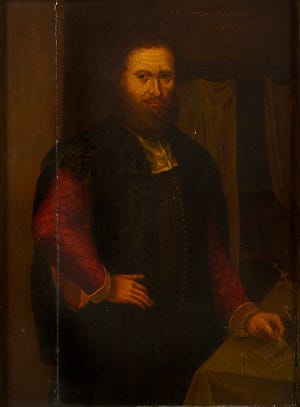
The late (egotistical and cantankerous) historian A. L. Rowse’s greatest claim to academic notoriety was his identification in January 1973 of a certain Aemilia Bassano as the “dark lady” of Shakespeare’s sonnets. Having examined the diaries of the Elizabethan doctor, astrologer and philanderer Simon Forman, in which she features as a client, Rowse concluded that Aemilia had the right theatrical connections and a suitably hot-blooded character. Did not Forman describe her as “brown in her youth” (obviously a dark lady) and note that her husband’s name was William (hence the double play on the name Will in several of the sonnets)?
A few months later it was pointed out by the BBC staffer and Elizabethan scholar Mary Edmond that Forman had actually written “brave in her youth” and that the husband’s name was Alfonso. But Rowse persisted to his dying day in the belief that he alone had solved the great literary mystery. Nor did his inability to read Forman’s handwriting deter him from making the diaries the basis of a book on Sex and Society in Shakespeare’s Age.
It is unfortunate that the life and writings of Dr Forman were for a long time inextricably linked with the quirks and vanity of Dr Rowse, because he was a man who reveals an immense amount about both the vitality and the strangeness of the Elizabethans.
Forman was born in Wiltshire in 1552. He hoped to follow the time-honoured path from grammar school to Oxford to London, but struggled for financial reasons. As a result, when he set himself up as a doctor - first in the provinces, eventually in the metropolis - he lacked the imprimatur of the College of Physicians. This body sought to operate a closed shop in the practice of medicine, so Forman was frequently rebuked, sometimes fined and even imprisoned.
Yet he seems to have found a winning formula with his mode of treatment that combined the casting of horoscopes with such attractive remedies as civet taken in poached egg for impotence and, for a bad knee, “a hote cow tord to be clapt on”. He built up a most impressive clientele, being regularly visited by courtiers, merchants, theatre people and all sorts.
He gained a particular reputation in the area of “women’s problems”. Word went out that, whether you were having difficulty with a pregnancy or in getting pregnant, Dr Forman was the man to visit. He kept detailed case notes, and a fantastic project at Cambridge University has digitized them … all 10,000 consultations between the years 1596 and 1603.
There we find such mysterious entries as “halek E parker 1598. 24 Novemb Friday pm at 15 post 9 et seminavi per multum semen et Matrix hausit multum virgam ad hoc tempus.” The “multum semen” offers a clue …
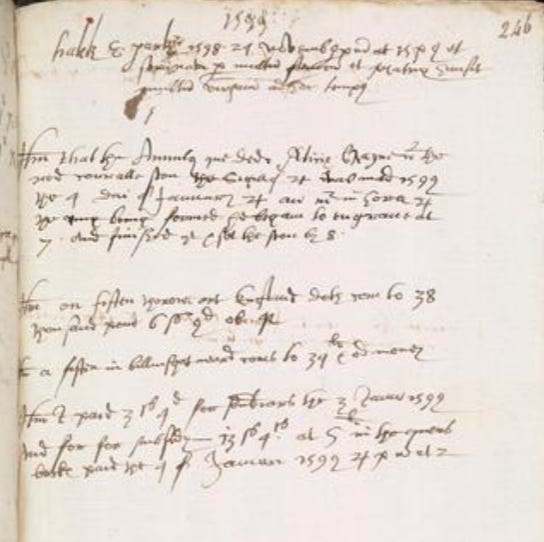
His journals have been known since the nineteenth century, when they were transcribed by the scholar J. O. Halliwell-Phillips, who backed off from a plan to publish them on account of the amount of “haleking” they contained. No one has ever worked out with certainty why Forman chose “halek” as his code-word for sexual intercourse. My guess would be that he was playing on a Greek root, “halek” has lexical resemblances to the Greek for “to grind” (αλέθω) and “to fish”(ἁλιεύω) - both verbs were Elizabethan slang for having sex, as we know from those dirty-minded characters Pandarus in Shakespeare’s Troilus and Cressida (“He that will have a cake out of the wheat must needs tarry the grinding”) and Pompey in Measure for Measure (“groping for trout in a peculiar river”).
Wherever the word “halek” came from, Forman certainly indulged in a prodigious amount of it. Even in his mid-fifties, we find him haleking with one Hester Sharp at 8am and Anne Wiseman at 3pm, then going home to halek with his wife, who was affectionately known as Tronco. He was as unscrupulous in taking advantage of his female patients as he was scrupulous in recording his every halek: “on April 12th at 4.10am, on the 14th at 9pm, the 21st at 5.45pm and on the 23rd at 5.30pm”. The precise times were necessary for the calculation of the astrological chart of any child conceived as the result of a particular halek.
Since he was not a member of the College of Physicians, he could not be, so to speak, struck off the medical register.
Forman’s dreams - especially one about a sexual encounter between himself, a tall red-bearded weaver and Queen Elizabeth dressed in nothing but a white shift and petticoat - provide extraordinary insights into the psychopathology of the Elizabethan age. Make of this what you will (Dr Freud would have something to say about the dirt, I suspect). Spelling modernized:
I dreamt that I was with the Queen, and that she was a little elderly woman in a coarse white petticoat all unready; and she and I walked up and down through lanes and closes, talking and reasoning of many matters. At last we came over a great close where were many people, and there were two men at hard words. One of them was a weaver, a tall man with a reddish beard, distract of his wits. She talked to him and he spoke very merrily unto her, and at last did take her and kiss her.
So I took her by the arm and put her away; and told her the fellow was frantic. And so we went from him and I led her by the arm still, and then we went through a dirty lane. She had a long white smock, very clean and fair, and it trailed in the dirt and her coat behind. I took her coat and did carry it up a good way, and then it hung too low before. I told her she should do me a favour to let me wait on her, and she said I should. Then, said I: ‘I mean to wait upon you, and not under you, that I might make this belly a little bigger to carry up this smock and coats out of the dirt.’
And so we talked merrily and then she began to lean upon me, when we were past the dirt, and to be very familiar with me, and methought she began to love me. And when we were alone, out of sight, methought she would have kissed me.
The weaver and the queen … surely he had seen A Midsummer Night’s Dream. And indeed his eye-witness accounts of some of Shakespeare’s plays are unique. Here is his account of one of my favourite plays, The Winter’s Tale:
In the Winter’s Tale at the Globe
1611 the 15 of May, Wednesday
Observe there how Leontes the king of Sicilia was overcome with jealousy of his wife with the king of Bohemia, his friend that came to see him; and how he contrived his death and would have had his cupbearer to have poisoned, who gave the king of Bohemia warning thereof and fled with him to Bohemia.
Remember also how he sent to the Oracle of Apollo and the answer of Apollo, that she was guiltless and that the king was jealous, etc., and how except the child was found again that was lost, the king should die without issue. For the child was carried into Bohemia and there laid in a forest and brought up by a shepherd and the king of Bohemia his son married that wench. And how they fled into Sicilia to Leontes, and the shepherd having showed the letter of the nobleman by whom Leontes sent was that child, and [by] the jewels found about her, she was known to be Leontes’s daughter, and was then 16 years old.
Remember also the rogue that came in all tattered like colt pixie, and how he feigned him sick and to have been robbed of all that he had and how he cozened the poor man of all his money, and after came to the sheep-shearer with a pedlar’s pack and there cozened them again of all their money. And how he changed apparel with the king of Bohemia his son, and then how he turned courtier, etc. Beware of trusting feigned beggars or fawning felons.
Intriguing that he is keen to remember the trickery of Autolycus but has nothing to say about the magic of the magical final scene in which Hermione’s statue (or, it is hinted, her pretending to be a statue) is brought to life.
I see he lived to 58. Do we know what he died of? Curious whether so much ‘haleking’ was a bliss or a very woe…
As for The Winter’s Tale, I can hear him singing with Autolycus: “What maids lack from head to heel. / Come, buy of me, come; come buy, come buy.”