
Two Dickensian Gardens
And praise of editors

Apologies to regular followers of this Substack: there was no post last week, because I was deep in correction of the proofs of my new – very long – book. It’s called The Garden: our 4,000 Year Quest for Paradise. The most ambitious project I’ve ever undertaken, it begins in Eden and ends in the present, or rather in the future (with an imagining of the future of gardening in an age of climate change).
Unlike most garden books, it is as much about the representation of gardens in literature and art as actual gardens; it attempts a symbiosis between the arts (and gardening is an art as well as a science). But I owe a debt to my editors – Arabella Pike at William Collins in London and Dan Halpern and Morgan Hamilton at Knopf in New York – for their help in unifying the structure. In particular they persuaded me to excise a chapter on gardens in the novel. It felt too much like an arbitrary set of brief sketches, not a sustained part of the argument. The solution they proposed exemplified editorial intervention at its best: each example, they said, should either be integrated elsewhere or removed altogether. It worked: the section on the opening of Henry James’s The Portrait of a Lady is now linked to the origin of the lawnmower, the treatment of Frances Hodgson Burnett’s The Secret Garden is now part of an account of the mental health benefits of gardening, and Virginia Woolf’s exquisite short story ‘Kew Gardens’ is … in the chapter on Kew Gardens.
Dickens, though, hit the cutting room floor. I just couldn’t find a place for my contrast between the gardens of Betsy Trotwood in David Copperfield and Miss Havisham in Great Expectations. So here is an outline of it. I began with David’s first meeting with his kindly, eccentric aunt:
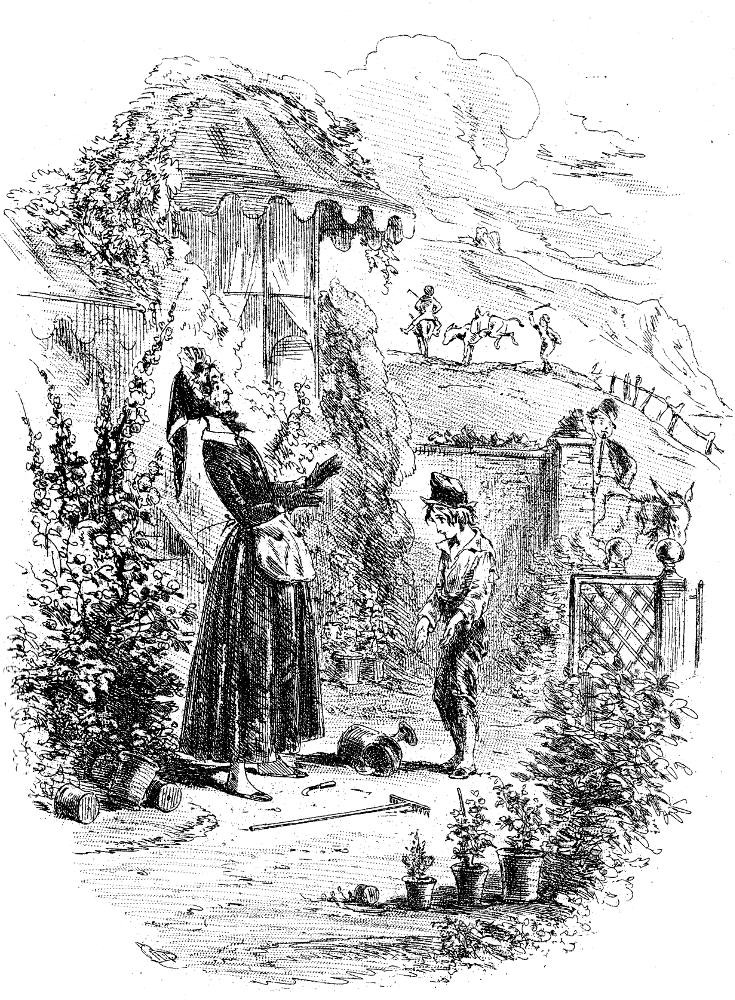
The man directed him towards some houses on the heights, and thither David toiled; a forlorn little creature, without a jacket or waistcoat, his white hat crushed out of shape, his shoes worn out, his shirt and trousers torn and stained, his pretty curly hair tangled, his face and hands sunburnt, and covered with dust. Lifting his big, wistful eyes to one of the windows above, he saw a pleasant faced gentleman with grey hair, who nodded at him several times, then shook his head and went away. David was just turning away to think what he should do, when a tall, erect, elderly lady, with a gardening apron on and a knife in her hand, came out of the house, and began to dig up a root in the garden.
I love that she first appears in full gardener’s kit. And of course Dickens then introduces the running joke of her battle to exclude donkeys from her little horticultural kingdom, even as she includes the hitherto exiled David:
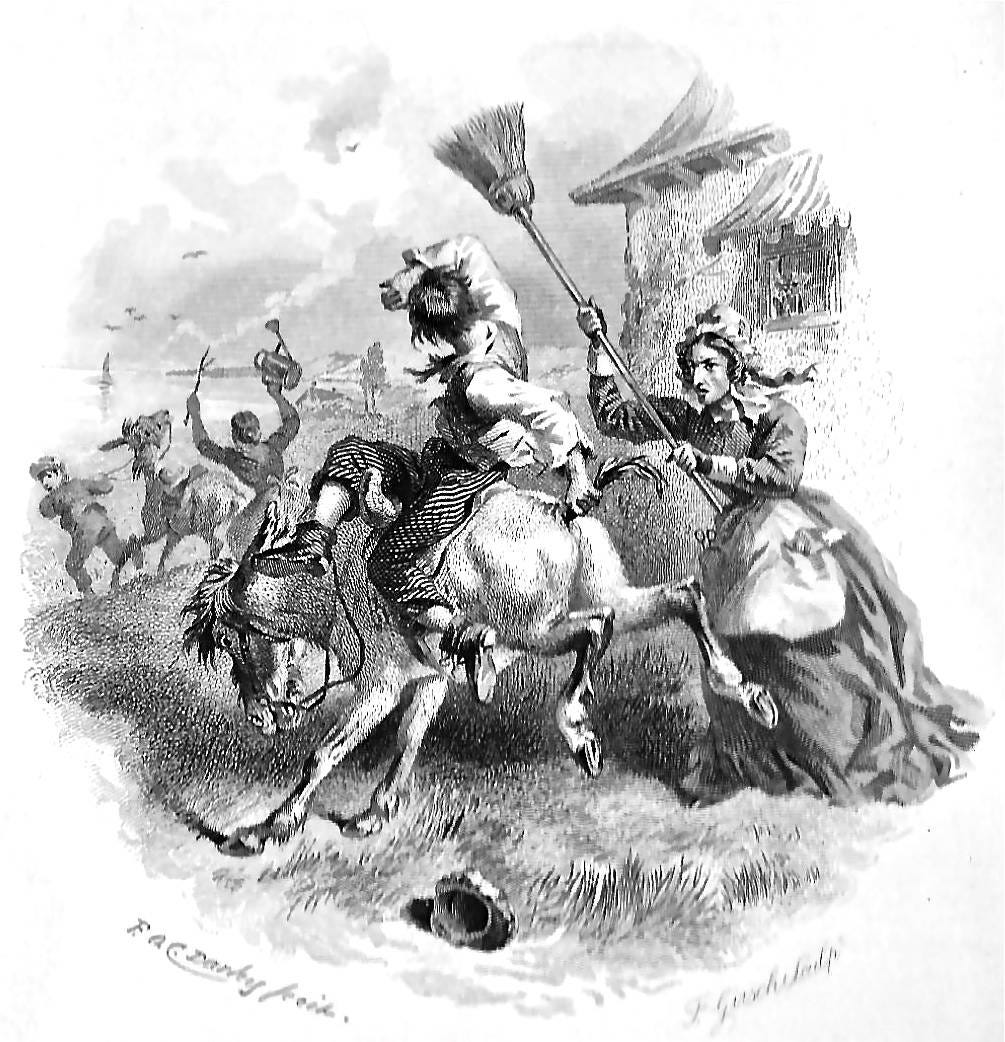
My aunt, to my great alarm, became in one moment rigid with indignation, and had hardly voice to cry out, “Janet! Donkeys!”
Upon which, Janet came running up the stairs as if the house were in flames, darted out on a little piece of green in front, and warned off two saddle-donkeys, lady-ridden, that had presumed to set hoof upon it; while my aunt, rushing out of the house, seized the bridle of a third animal laden with a bestriding child, turned him, led him forth from those sacred precincts, and boxed the ears of the unlucky urchin in attendance who had dared to profane that hallowed ground.
The overgrown garden of Miss Havisham’s Satis House is the very opposite.
What is the matter?” asked Estella. “Are you scared again?”
“I should be, if I believed what you said just now,” I replied, to turn it off.
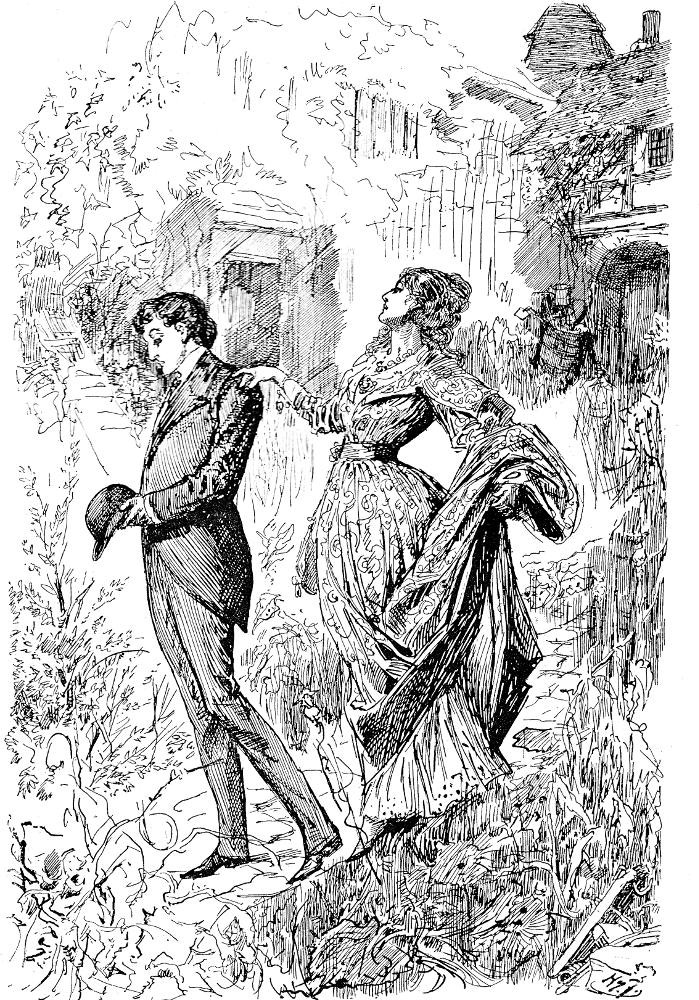
“Then you don’t? Very well. It is said, at any rate. Miss Havisham will soon be expecting you at your old post, though I think that might be laid aside now, with other old belongings. Let us make one more round of the garden, and then go in. Come! You shall not shed tears for my cruelty to-day; you shall be my Page, and give me your shoulder.”
Her handsome dress had trailed upon the ground. She held it in one hand now, and with the other lightly touched my shoulder as we walked. We walked round the ruined garden twice or thrice more, and it was all in bloom for me. If the green and yellow growth of weed in the chinks of the old wall had been the most precious flowers that ever blew, it could not have been more cherished in my remembrance.
Pip’s first encounter with the estate has established its atmosphere of arrested putrefaction: he sees that “The rank garden was the garden of the house, and that it was overgrown with tangled weeds.” The forsaken domain mirrors the mistress who has forgotten how to live. The adjective “rank” carries multiple charges: socially degraded, morally corrupted, foul with the smell of things that should have moved on but haven’t. Miss Havisham, with withered bridal flowers in her hair, embodies fertility perverted into sterile obsession. Abandoned at the altar, she has transformed her estate into a shrine to interrupted promise, a museum of mental damage where every clock has been stopped at twenty minutes to nine. Garden maintenance has ceased at the same moment. In this suspended world, Estella can be raised as an instrument of retribution against the entire male sex, shaped by an environment where natural processes have been deliberately arrested. When she walks with Pip in the garden, her flirtation may be cruel and yet it transforms the garden in his eyes:
What is the matter?” asked Estella. “Are you scared again?”
“I should be, if I believed what you said just now,” I replied, to turn it off.
“Then you don’t? Very well. It is said, at any rate. Miss Havisham will soon be expecting you at your old post, though I think that might be laid aside now, with other old belongings. Let us make one more round of the garden, and then go in. Come! You shall not shed tears for my cruelty to-day; you shall be my Page, and give me your shoulder.”
Her handsome dress had trailed upon the ground. She held it in one hand now, and with the other lightly touched my shoulder as we walked. We walked round the ruined garden twice or thrice more, and it was all in bloom for me. If the green and yellow growth of weed in the chinks of the old wall had been the most precious flowers that ever blew, it could not have been more cherished in my remembrance.
At last, however, the novel’s revised conclusion allows for tentative renewal. Upon Pip’s final return, he finds that “There was no house now, no brewery, no building whatever left, but the wall of the old garden. The cleared space had been enclosed with a rough fence, and, looking over it, I saw that some of the old ivy had struck root anew, and was growing green on low quiet mounds of ruin. A gate in the fence standing ajar, I pushed it open, and went in.” Regeneration. It is here in the garden that he is reunited with Estella and anticipates “no shadow of another parting from her.”
The Garden will be published in the UK in October 2026 and the USA in February 2027.
Looking forward to adding your new book to the others on my shelf.
Interesting to think about Great Expectations. The novel opens in a sort of garden, and the emphasis on (over)growth and uncultivated nature is clear.
“Ours was the marsh country, down by the river, within, as the river wound, twenty miles of the sea. My first most vivid and broad impression of the identity of things, seems to me to have been gained on a memorable raw afternoon towards evening. At such a time I found out for certain, that this bleak place overgrown with nettles was the churchyard; and that Philip Pirrip, late of this parish, and also Georgiana wife of the above, were dead and buried; and that Alexander, Bartholomew, Abraham, Tobias, and Roger, infant children of the aforesaid, were also dead and buried; and that the dark flat wilderness beyond the churchyard, intersected with dykes and mounds and gates, with scattered cattle feeding on it, was the marshes; and that the low leaden line beyond, was the river; and that the distant savage lair from which the wind was rushing, was the sea; and that the small bundle of shivers growing afraid of it all and beginning to cry, was Pip.”
And where is Great Expectations set? Kent. The garden of England.
Beautiful and funny...