

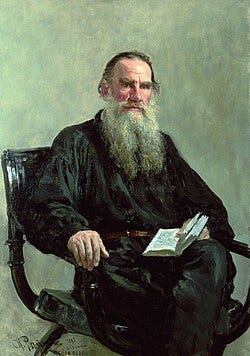
I’ve been rereading Tolstoy’s extraordinary book What Is Art? I think it’s hilarious and in many ways wrongheaded, but also full of wisdom. For those who don’t know it: early in the book there’s a wonderful account of how he goes to the theatre to watch the rehearsal of an opera. What strikes him is the extraordinary labour involved: exhausted workers, performers being shouted at and abused, enormous amounts of human effort going into the production of an elaborate luxury. And the audience who will come to see the final product is posh and wealthy. So his mind turns to the peasants whose labour ultimately pays for the creation of art. And that leads him to ask: What justification is there for all this high culture? What makes it worth the human cost?
He goes on to attack the whole tradition of aesthetics, which he traces through Baumgarten and then Kant, Schopenhauer and others: the idea, as the philosophers have it, that art is essentially concerned with beauty. So what is beauty? Beauty, says Tolstoy, turns out in the end to mean something that gives pleasure. But pleasure to whom? The answer, he says, is “us”. We who are educated, who are leisured, who can afford to go to the opera. So the aesthetic turns out to be an elaborate way of legitimating the tastes of the wealthy. “We” call the things that please us beautiful, and then construct a philosophy which explains why everyone else ought to regard them as great art.
Having denounced the traditional approach, what does Tolstoy do next? He says that art is essentially the communication of feeling. The artist experiences a feeling and, through words, sounds, images, movements, manages to make other people experience it too. This shift towards strong feeling, the affective power of art, belongs to the Romantic tradition. I’m reminded of Wordsworth speaking about poetry and the communication of powerful feeling, defining the true poet as “a man speaking to men,” creating in his audience the same strong emotions that he has experienced himself. Crediting Coleridge with the thought, Wordsworth wrote of how true artists will create a connection, a bond, a shared feeling with their audience: “every Author, as far as he is great and at the same time original, has had the task of creating the taste by which he is to be enjoyed.”
The Russian word Tolstoy uses is zarazhenie which means infection, contagion. It’s as if art is like catching something, catching a virus. A boy who tells his fellow villagers that he met a wolf in the forest and makes them feel the fear that he felt is in some sense an artist. The composer of a fashionable symphony who leaves us impressed at the technical skill, but communicates no feeling to us, is not.
Fair enough. Infectiousness tells us whether something is art, but it doesn’t tell us whether it is good art. A work could infect us extremely successfully with feelings that are cruel, vain or vicious. So for Tolstoy, what is good art? Here the answer is consonant with his own belief system: above all, the brotherhood of all people. You remember his conversion to a very specific Christian idea of renunciation and caritas. True art inspires universal human brotherhood - though he also grants that there is value in art that simply communicates strong feelings to a wide audience (though the feelings in question must not be in opposition to that religious consciousness). Good art doesn’t necessarily have to preach a sermon about brotherhood - the aforementioned village boy’s story, or maybe a folk song, can qualify. What matters is that art should be capable of bringing human beings into a shared world of feeling.
Bad art, by contrast, divides us. It is exclusive. Indeed, for Tolstoy the fact that you have to be educated for years before you can appreciate something is not an argument in its favour but a reason to be suspicious of it. He takes the example of Wagner and gives a hilarious description of what it was like to sit through a performance of Siegfried. And he’s equally harsh about many of the acknowledged masterpieces of Western art: Beethoven’s late string quartets and Ninth Symphony, the poetry of Baudelaire and Mallarmé, the plays of Ibsen, even Michelangelo’s Last Judgement. Even - this has its own comic aspect - War and Peace and Anna Karenina come under suspicion. He is perfectly prepared to apply the axe to himself.
What survives in his canon are works that either advance this sense of human brotherhood or have a kind of class-free accessibility: Harriet Beecher Stowe’s Uncle Tom’s Cabin, the book that did so much to advance the abolitionist cause; Dickens the social reformer, especially A Tale of Two Cities and A Christmas Carol; Victor Hugo; the biblical story of Joseph and his brothers; a peasant painted by Millet; a folk song sung well. Quite some leveling: a peasant song may be greater art than an opera; a story told by a child may succeed where a technically dazzling symphony fails.
It seems a counter-intuitive argument, a bit like his belief that Shakespeare was no good (a prejudice beautifully speared by George Orwell). But once you’ve read the book, you have to think: yes, he is on to something. Who pays for the art? Who is admitted to the table? Who has been educated into understanding it, and who is told that their failure to understand it is their own fault? What’s it all for?
And perhaps the deepest idea in the book is that art isn’t primarily a special class of beautiful objects at all. It’s a form of human relationship. So “Is this beautiful?” and “Does this give me pleasure?” are the wrong questions. You have to ask instead what kind of relationship between human beings does it create?
He’s wrong, of course, about nearly every particular judgement (says I, says the critical tradition). Beethoven survives Tolstoy’s attack on Beethoven - the Ninth Symphony survives as one of the greatest proclamations of human brotherhood. But the principle - the idea that art is dangerously capable of becoming exclusive, that it rests on material and social conditions we prefer not to think about, and above all that it is affective, something human beings do to and with one another - remains very powerful.
Something Tolstoy fails to recognize is that its capacity to affect different people in different ways and to speak to different ages and different cultures is what really makes art different from, say, science.
Had Einstein not worked out the equation e=mc2, someone else would have done so a few years later. If there had been no Darwin, Alfred Wallace would have been credited with the discovery that evolution functions through natural selection. But if Shakespeare had not written The Tempest, no one else would have done. And if there had been no Beethoven, the whole history of music would have been different.
Every great work of art has an autonomy, a life of its own, independent from that of its author and from the restrictive conditions of the historical moment at which it is produced. The capacity to continue to speak to new generations and unknown audiences is the only sure test of artistic greatness. As Dr Samuel Johnson put it, to endure for more than a century is the true mark of value. His contemporary David Hume made the same point more capaciously:
The same Homer, who pleased at Athens and Rome two thousand years ago, is still admired at Paris and at London. All the changes of climate, government, religion, and language, have not been able to obscure his glory. Authority or prejudice may give a temporary vogue to a bad poet or orator; but his reputation will never be durable or general. When his compositions are examined by posterity or by foreigners, the enchantment is dissipated, and his faults appear in their true colours. On the contrary, a real genius, the longer his works endure, and the more wide they are spread, the more sincere is the admiration which he meets with. Envy and jealousy have too much place in a narrow circle; and even familiar acquaintance with his person may diminish the applause due to his performances: But when these obstructions are removed, the beauties, which are naturally fitted to excite agreeable sentiments, immediately display their energy; and while the world endures, they maintain their authority over the minds of men.
“Of the Standard of Taste” (1757)
The modern equivalent of the first half of Tolstoy’s essay - the critique of art’s elitism on social and political grounds - might be found in the work of the “new historicist” literary and cultural critics of the 1980s and 1990s. Most of them were middle-aged Leftists from the class of ’68. Their gospel was a form of neo-Marxist determinism. They argued that, far from being autonomous, literary works cannot be separated from their cultural context. According to this model, literature is determined by, to quote one theorist, “the social, ideological, and material matrix in which all art is produced and consumed”. “New historicists” proposed that novels, poems and plays are shaped not so much by individual authors as by “the social energies of the age” or “the multiple agencies of literary production”. The twenty-first century twist on this idea is that not just novels, poems and plays, but also the entire canon of western art, has always been imprisoned by structures of race, gender and class. (Though it is striking that race and gender - “white supremacy” and “patriarchy” - have in recent years garnered much more attention than class, the category that preoccupied, indeed agonized, Count Tolstoy.)
Of course all art is influenced by social and historical context - what human activity is not? And of course artists of the past were infected, and contributed to the wider infection of their societies, with prejudice. The anti-semitism of Dickens’ representation of Fagin or of T. S. Eliot’s “Sweeney among the Nightingales”, the routine racial prejudice that stains generations. Equally, when Wordsworth wrote “a man speaking to men”, he didn’t mean that women can’t be writers or readers. He knew that his own sister was a wonderful writer and his own best reader. He was using “man” to “human” and that is a symptom of the patriarchy of his age.
But what makes great art special is precisely its capacity to resist context. It accordingly behoves the reader or spectator or listener to look beyond the prejudice. To find, as it were, the life-affirming infection or affect as opposed to the toxic contagion. Hume is again good on not allowing our values to prejudice our judgment of works from other ages and cultures, all of which have their own, often quite different, prejudices (crude example - it is an error to judge ancient Greek attitudes to pederasty by modern ethical standards). The good critic: “the more fully to execute this undertaking, he must preserve his mind free from all prejudice, and allow nothing to enter into his consideration, but the very object which is submitted to his examination.” The bad critic: “If the work be addressed to persons of a different age or nation, he makes no allowance for their peculiar views and prejudices; but, full of the manners of his own age and country, rashly condemns what seemed admirable in the eyes of those for whom alone the discourse was calculated” (both quotes, again, from “Of the Standard of Taste”).
Indeed, major creative works have an autonomy that resists not just their context, but even their creators. John Keats remarked in a letter, “Things which I do half at random are afterwards confirmed by my judgment in a dozen features of propriety.” That is to say, artists are not fully in control of the processes whereby their creations come into being.
But it is the artwork itself, not the ideological context, which does the controlling. A true artistic work is one that takes on a life of its own, like Pygmalion’s statue. In some mysterious sense, it creates its own shape (“That which is creative must create itself” - Keats again). It’s only after you’ve finished weaving a book or composing a sonata or daubing a painting that you see the figure in the carpet.
Sometimes artists don’t ever see it themselves - and that is where the critic comes in. For determinist critics, artworks are like mass-produced Belgian carpets: the same few (ideological) figures are reproduced over and over again. For intuitive critics, each artwork of substance, like a hand-crafted Persian or Afghan rug, has its own individual figure, which is worth patient elucidation.1
An earlier version of the latter part of this post formed my review of Richard Lansdown, The Autonomy of Literature (2001).
So agree with this (and that Tolstoy, esp in later years, had some crackers ideas). I v much like Jonathan Rose's book on the intellectual life of the British working classes which exactly shows how the "uneducated" had massive appreciation of "high" culture. The question of reproduction of art works, of which Hay Wains on biscuit tins is a great example, is a slightly different and equally fascinating one - see Walter Benjamin's great essay on the work of art in the age of mechanical reproduction, where he talks about the loss of the "aura" that the original has.
Interesting post, thank you.
One of the most popular works of art in 20th century Britain was The Hay Wain, by John Constable; framed prints, prints on plates, biscuit tins, trays, trinket boxes, it could be found in thousands of homes up and down the country. Was this a "contagion" ? Or, like a picture of a loved relative, was it a work of art in memory of a beautiful aspect of the past, which people wanted to hold onto in the different, modern present ?
Tolstoy's contagion idea is a bit like Jung's collective unconscious, perhaps it's the same thing, but, where The Hay Wain is concerned anyway, that seems to me to leave out all those individual's feelings and attachment to their dreams and experience of the countryside, which The Hay Wain might have exemplified for them during the 20th century.
I do not think high art is only for the wealthy and well educated. Ordinary people enjoyed Shakespeare, Dickens, and others before the tv began to have its effect. During WWII Myra Hess played Bach for free to packed out audiences of soldiers and ordinary Londoners.
Tolstoy is one of my favourite writers, but he did have some funny ideas I think.