
More thoughts on E. M. Forster
On closeted silence and an unwritten sequel

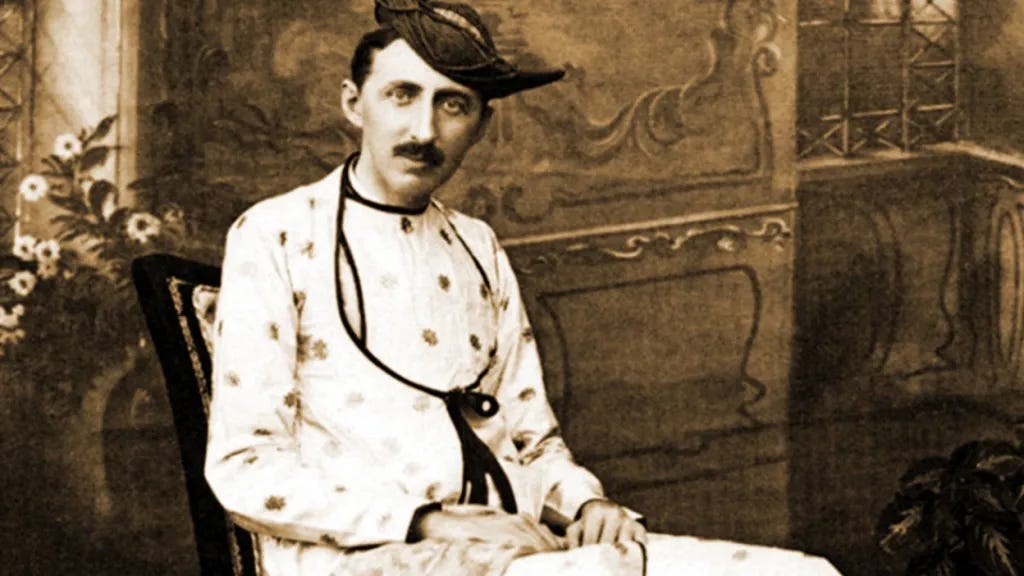
Last week I wrote about the critic Frank Kermode, beginning from his last book, which was on E. M. Forster. Rereading that, I was struck that Sir Frank was not at all interested in Forster’s sexuality. In one respect, I thought “good”: as a general rule, one should be wary of claims that the secret to the careers of writers and artists is their sex lives. Shakespeare was probably bisexual and Henry James a repressed homosexual, but to suggest that their sexuality is the hidden key that unlocks their writing lives is to oversimplify and sensationalise matters of great complexity and mystery.
But the case of Edward Morgan Forster is the exception that proves the rule. In 1924, to great acclaim, he published A Passage to India. He was 45, exactly half way through his long life. Before the Great War, he had published a sequence of novels of ever-increasing deftness, style and human understanding: Where Angels Fear to Tread, The Longest Journey, A Room with a View, and the incomparable Howards End. He was widely regarded by his peers, including figures as diverse as Virginia Woolf and D. H. Lawrence, as the greatest living English novelist.
From this time forth, he never published another novel. He remained highly productive as a writer: there were essays and radio talks, travel books and biographies, short stories and the libretto for Benjamin Britten’s Billy Budd. But no more novels.
Why? That was the question that tormented serious novel readers from the thirties to the sixties. Was this the longest case of writer’s block in recorded history?
The answer came in 1971, within a year of Forster’s death. There was a sixth novel, after all: the explicitly homosexual love story Maurice. In the summer of 1914, Forster had confided to his friend Florence Barger, “I have almost completed a long novel, but it is unpublishable until my death and England’s.” A visit to Edward Carpenter, the elderly writer and radical activist who lived in domestic bliss with his much younger working-class lover George Merrill, had persuaded him that it was possible to write a gay love story with a happy ending. But to publish it would have been to ruin his reputation and to risk the prosecution of any publisher who dared to print it. Not to mention a future in which the police would certainly take a close interest in his own private life.
This was Forster’s dilemma. There was a moral compass at the absolute centre of his novels: the search for honesty in love. Forster’s heroines—Lucy in A Room with a View, Helen Schlegel in Howards End—refuse to make the respectable marriages expected of middle-class girls. They wrestle with their conscience and follow their hearts. A Passage to India ends by imagining a close friendship between the Englishman Fielding and the Indian Aziz. It brought Forster’s art to a point after which the only honest next step would have been to write openly about the love that consumed his own heart. The love that dared not speak its name.
The irony is that Forster was forced into an awkward compromise of exactly the sort that characterizes the muddle and disconnect of the peculiar kind of Englishness that his books had anatomized. Was his silence a courageous rejection of the heterosexual orthodoxy that had defined the English novel since its birth in the eighteenth century? Or was his suppression of Maurice an act of moral cowardice? In 1928 he was prepared to speak up on behalf of Radclyffe Hall’s lesbian The Well of Loneliness. But even after the Wolfenden Report three decades later, he still refused to go public as a gay novelist himself or indeed to publish Maurice.
He collected his essays on politics and public affairs under the title Two Cheers for Democracy. But do his own compromises deserve any hurrahs at all? Nearly all his friends, in the Bloomsbury set and beyond, knew that he was gay, but the reading public didn’t. He had a very active sex life, in terms of both casual affairs and great passions (the loves of his life were first a beautiful young Egyptian Muslim named Mohammed el Adl, then the married policeman Bob Buckingham). He could not contemplate coming out to his overbearing mother, who had brought him up alone after father’s premature death, and with whom he lived for much of his life. Was it just too late for him to change by the time she died in 1945? That freed him to return to Cambridge and the company of such gay men as Dadie Rylands. But perhaps by then it was simply too late to come out of the closet. Half a life wasted?
The pathos — or is it the bathos? — of that waste comes across in a piece that Forster wrote in 1958, exactly half a century after the publication of A Room with a View. Entitled, “A View without a Room,” it imagined the afterlives of the characters. It is, in essence, a synopsis of an unwritten sequel – a sequel he could not or would not write, because of that question of being honest to his own kind of love.
Here it is:
“A View without a Room”
A Room with a View was published in 1908. Here we are in 1958 and it occurs to me to wonder what the characters have been doing during the interval. They were created even earlier than 1908. The Italian half of the novel was almost the first piece of fiction I attempted. I laid it aside to write and publish two other novels, and the returned to it and added the English half. It is not my preferred novel – The Longest Journey is that – but it may fairly be called the nicest. It contains a hero and heroine who are supposed to be good, good-looking and in love – and who are promised happiness. Have they achieved it?
Let me think.
Lucy (Mrs George Emerson) must now be in her late sixties, George in his early seventies – a ripe age, though not as ripe as my own. They are still a personable couple, and fond of each other and of their children and grandchildren. But where do they live? Ah, that is the difficulty, and that is why I have entitled this article ‘A View without a Room’. I cannot think where George and Lucy live.
After their Florentine honeymoon they probably settled down in Hampstead. No – in Highgate. That is pretty clear, and the next six years were from the point of view of amenity the best they ever experienced. George cleared out of the railway and got a better-paid clerkship in a government office, Lucy brought a nice little dowry along with her, which they were too sensible not to enjoy, and Miss Bartlett left them what she termed her little all. (Who would have thought it of Cousin Charlotte? I should never have thought anything else.) They had a servant who slept in, and were becoming comfortable capitalists when World War I exploded – the war that was to end war – and spoiled everything.
George instantly became a conscientious objector. He accepted alternative service, so did not go to prison, but he lost his government job and was out of the running for Homes for Heroes when peace came. Mrs Honeychurch was terribly upset by her son-in-law’s conduct.
Lucy now got on her high horse and declared herself a conscientious objector too, and ran a more immediate risk by continuing to play Beethoven. Hun music! She was overheard and reported, and the police called. Old Mr Emerson, who lived with the young couple, addressed the police at length. They told him he had better look out. Shortly afterwards he died, still looking out and confident that Love and Truth would see humanity through in the end.
They saw the family through, which is something. No government authorized or ever will authorize either Love or Truth, but they worked privately in this case and helped the squalid move from Highgate to Carshalton. The George Emersons now had two girls and a boy and were beginning to want a real home – somewhere in the country where they would take root and unobtrusively found a dynasty. But civilization was not moving that way. The characters in my other novels were experiencing similar troubles. Howard’s End is a hunt for a home. India is a Passage for Indians as well as English. No resting-place.
For a time Windy Corner dangled illusively. After Mrs Honeychurch’s death there was a chance of moving into that much loved house. But Freddy, who had inherited it, was obliged to sell and realize the capital for the upbringing of his family. And unsuccessful yet prolific doctor, Freddy could not do other than sell. Windy Corner disappeared, its garden was built over, and the name of Honeychurch resounded in Surrey no more.
In due course World War II broke out – the one that was to end with a durable peace. George instantly enlisted. Being both intelligent and passionate, he could distinguish between a Germany that was not much worse than England and a Germany that was devilish. At the age of fifty he could recognize in Hitlerism an enemy of the heart as well as of the head and the arts. He discovered that he loved fighting and had been starved by its absence, and also discovered that away from his wife he did not remain chaste.
For Lucy the war was less varied. She gave some music lessons and broadcast some Beethoven, who was quite all right this time, but the little flat at Watford, where she was trying to keep things together against George’s return, was bombed, the loss of her possessions and mementos was complete, and the same thing happened to their married daughter, away at Nuneaton.
At the front George rose to the rank of corporal, was wounded and taken prisoner in Africa, and imprisoned in Mussolini’s Italy, where he found the Italians sometimes sympathetic as they had been in his tourist days, and sometimes less sympathetic.
When Italy collapsed he moved northward through the chaos towards Florence. The beloved city had changed, but not unrecognizably. The Trinita Bridge had been destroyed, both ends of the Ponte Vecchio were in a mess, but the Piazza Signoria, where once a trifling murder had occurred, still survived. So did the district where the Pension Bertolini had once flourished – nothing damaged at all.
And George set out – as I did myself a few years later – to locate the particular building. He failed. For though nothing is damaged all is changed. The houses on that stretch of the Lungarno have been renumbered and remodelled and, as it were, remelted, some of the facades have been extended, others have shrunk, so that it is impossible to decide which room was romantic half a century ago. George had therefore to report to Lucy that the View was still there and that the Room must be there, too, but could not be found. She was glad of the news, although at that moment she was homeless. It was something to have retained a View, and, secure in it and in their love as long as they have one another to love, George and Lucy await World War III – the one that would end war and everything else, too.
Cecil Vyse must not be omitted from this prophetic retrospect. He moved out of the Emersons’ circle but was not altogether out of mine. With his integrity and intelligence he was destined for confidential work, and in 1914 he was seconded to Information or whatever the withholding of information was then entitled. I had an example of his propaganda, and a very welcome one, at Alexandria. A quiet little party was held on the outskirts of that city, and someone wanted a little Beethoven. The hostess demurred. Hun music might compromise us. But a young officer spoke up. ‘No, it’s all right,’ he said, ‘a chap who know about those things from the inside told me Beethoven’s definitely Belgian.’
The chap in question must have been Cecil. The mixture of mischief and culture is unmistakable. Our hostess was reassured, the ban was lifted, and the Moonlight Sonata shimmered into the desert.
“No government authorized or ever will authorize either Love or Truth”: the Wolfenden Report had been published a year before Forster wrote this, so I guess that here he is anticipating that its recommendation to legalize homosexuality will never be realized - and of course it did take ten years before that happened.
But don’t you think he might have got away with some subtle gay hints if he had written this sequel: could he have made George’s wartime infidelities in Italy a little experimental? And surely the “mixture of mischief and culture” in Cecil, and the fact that he is “not altogether out of” Forster’s circle, are strong suggestions? Where better for Cecil to have come fully “out” than the very city in Egypt where in the first war Forster himself fell passionately in love with the Alexandrian tram driver Mohammed el-Adl and found sexual fulfilment for the first time?
I wonder if it’s partly a matter of temperament. Gore Vidal, who didn’t much like Forster but loved his novels, knew all hell would break loose when he published The City and the Pillar - and he did it anyway. Forster feels like a different case. English, older, Older, more ‘comfortable,’ less inclined to invite the trouble. Not cowardly, but less eager to turn private feelings into public confrontation. In Maurice, he writes: “Where all is obscure and unrealised the best similitude is a dream.” Perhaps his dream was sufficient.
I had the vague impression he'd stopped writing novels after becoming an active homosexual, or something along those lines... Don't know if that's true or even close to it.